Portuguese (português) is an Indo-European language of the Romance branch. It originated in what is today Galicia (in Spain) and northern Portugal. It is the official language of Angola, Brazil, Cape Verde, Guinea-Bissau, Mozambique, Portugal and São Tomé and Príncipe, co-official with Chinese in the Chinese S.A.R. of Macau, and co-official with Tetum in East Timor.
Portuguese is ranked sixth among the world's languages in number of native speakers (over 200 million), and first in South America (186 million, over 51% of the population). It is also a major lingua franca in Africa. It spread worldwide in the 15th and 16th century as Portugal set up a vast colonial and commercial empire (1415–1999), spanning from Brazil in the Americas to Macau in China. In that colonial period, many Portuguese creoles appeared around the world, especially in Africa, Asia and the Caribbean.
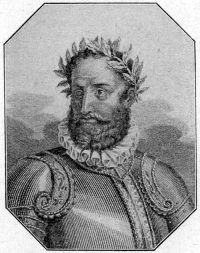
Portuguese is often nicknamed The language of Camões, after the author of the Portuguese national epic The Lusiads; The last flower of Latium (Olavo Bilac); and The sweet language by Cervantes.
Geographic distribution
Geographic distribution of Portuguese
Portuguese is the first language in Angola, Brazil, Portugal and São Tomé and Príncipe, and the most widely used language in Mozambique. It is also one of the official languages of East Timor (with Tetum) and of the Chinese S.A.R. of Macau (with Chinese). It is widely spoken, but not official, in Andorra, Luxembourg, Namibia and Paraguay. Portuguese Creoles are the mother tongue of Cape Verde and part of Guinea-Bissau's population. In Cape Verde most also speak standard Portuguese and have a native level language usage.
Large Portuguese-speaking immigrant communities exist in many cities around the world, including Montreal and Toronto in Canada; Paris in France; Asunción in Paraguay; and Boston, New Bedford, Cape Cod, Fall River, Honolulu, Houston, Newark, New York City, Orlando, Miami, Providence, Sacramento in the United States; Buenos Aires in Argentina, Uruguay, and in Japan. Other countries where speakers can be found include in Andorra, Belgium, Bermuda, Switzerland and some communities in India such as Goa. Portuguese is spoken by about 187 million people in South America, 17 million in Africa, 12 million in Europe, 2 million in North America and 610,000 in Asia.
Countries and regions where Portuguese has official status.

The CPLP or Community of Portuguese Language Countries is an international organization consisting of the eight independent countries which have Portuguese as an official language. Portuguese is also an official language of the European Union, Mercosul and the African Union (one of the working languages) and one of the official languages of other organizations. The Portuguese language is gaining popularity in Africa, Asia, and South America as a second language for study.
Portuguese is with Spanish the fastest growing western language, and, following estimates by UNESCO it is the language with the higher potentiality of growth as an international communication language in Africa (south) and South America. The Portuguese speaking African countries are expected to have a combined population of 83 million by 2050. After Brazil signed into the economic market of Mercosul with other South America nations, such as Argentina, Uruguay, and Paraguay, there has been an increase in curiosity towards study of Portuguese language in those South American countries. The demographic weight of Brazil in the continent will continue to strengthen the presence of Portuguese language in the region.

Estação da Luz, site of the museum, in São Paulo, Brazil.
The language is also starting to gain popularity in Asia, mostly due to East Timor's boost in the number of speakers in the last five years, and Macau is becoming the Chinese center for learning Portuguese, where in early 21st century, the language use was in decline, today it is growing as it became a language for opportunity due to increased Chinese diplomatic and financial ties with the Portuguese speaking countries.
In March of 2006, the Museum of the Portuguese Language, an interactive museum about the Portuguese language was founded in São Paulo, Brazil, the city with the largest number of Portuguese speakers in the world.
[edit]
Dialects
Portuguese dialects
There are two main groups of dialects, those of Brazil and those of the Old World. For historical reasons, the dialects of Africa and Asia are generally closer to those of Portugal than the Brazilian dialects, although in some aspects of their phonology, especially the pronunciation of unstressed vowels, they resemble Brazilian Portuguese more than European Portuguese. They have not been studied as exhaustively as European and Brazilian Portuguese. In various parts of Africa, Asia, and the Americas, Portuguese creoles are spoken, but they are independent languages which should not be confused with Portuguese itself.
Within the two major varieties of Portuguese, most differences between dialects concern pronunciation and vocabulary. Below are some examples:
Words for bus
Angola & Mozambique: machimbombo
Brazil: ônibus
Portugal: autocarro
Words for slum quarter
Angola: musseque
Brazil: favela
Portugal: bairro de lata or ilha
slang terms for to go away
Angola: bazar - from Kimbundu kubaza - to break, leave with rush
Brazil: vazar - from Portuguese "to leak"
Portugal: bazar - from Kimbundu kubaza - to break, leave with rush
Between Brazilian Portuguese, particularly in its most informal varieties, and European Portuguese, there can be considerable differences in grammar, as well. The most prominent ones concern the placement of clitic pronouns, and the use of subject pronouns as objects in the third person. Non-standard inflections are also common in colloquial Brazilian Portuguese.
[edit]
Classification and related languages
Portuguese belongs to the West Iberian group of the Romance languages, and it has special ties with the following members of this group, for various reasons:
* Galician and the Fala, its closest relatives. See below.
* Spanish, the major language closest to Portuguese. See also Differences between Spanish and Portuguese.
* Mirandese, another West Iberian language spoken in Portugal.
* Judeo-Portuguese and Judeo-Spanish, languages spoken by Sephardic Jews, which remained close to Portuguese and Spanish.
Latin and other Romance languages
A distinctive feature of Portuguese is that it preserved the stressed vowels of Vulgar Latin, which other Romance languages diphthongized; cf. Fr. pierre, Sp. piedra, Port. pedra, from Lat. petra; It. fuoco, Sp. fuego, Port. fogo, from Lat. focum. Another characteristic of early Portuguese was the loss of intervocalic l and n, followed by the merger of the two surrounding vowels, or by the insertion of an epenthetic vowel between them: cf. Lat. salire, tenere, catena, Sp. salir, tener, cadena, Port. sair, ter, cadeia.
When the elided consonant was n, it often nasalized the preceding vowel: cf. Lat. manum, rana, bonum, Port. mão, rãa (now rã), bõo (now bom). This process was the source of most of the nasal diphthongs which are typical of Portuguese. In particular, the Latin endings -ane-, -anu- and -one- became -ão in most cases: cf. Lat. canem, germanum, rationem with Modern Port. cão, irmão, razão, and their plurals cães, irmãos, razões.
See Portuguese Vocabulary: From Latin to Portuguese, for other sound changes.
In spite of the obvious lexical and grammatical similarities between Portuguese and other Romance languages outside the West Iberian branch, it is not mutually intelligible with them to any practical extent. Portuguese speakers will usually need some formal study of basic grammar and vocabulary, before being able to understand even the simplest sentences in those languages (and vice-versa):
Ela fecha sempre a janela antes de jantar. (Portuguese)
Ella cierra siempre la ventana antes de cenar. (Spanish)
Lei chiude sempre la finestra prima di cenare. (Italian)
Ella tanca sempre la finestra abans de dinar. (Catalan)
Elle ferme toujours la fenêtre avant de dîner. (French)
Ea închide întodeauna fereastra înainte de a cina. (Romanian)
"She always shuts the window before dining."
Note that some of the lexical divergence above actually comes from different Romance languages using the same root word with different semantic values. Portuguese for example has the word fresta, which is a cognate of French fenêtre or Italian finestra, but now means "slit" as opposed to "window". Likewise, Portuguese also has the word cear, a cognate of Italian cenare and Spanish cenar, but uses it in the sense of "to have a late supper", while the most frequent word meaning "to dine" is actually jantar.
[edit]
Galician and the Fala
The closest language to Portuguese is Galician, spoken in the autonomous community of Galicia (Northwest Spain). They were at one time a single language, known today as Galician-Portuguese, but since the political separation of Portugal from Galicia they have diverged somewhat. Galician has kept only the seven oral vowels of medieval Galician-Portuguese; it has no central vowels or nasal vowels. Around the Renaissance, its consonants went through significant changes which closely paralleled the evolution of the Spanish consonants. After many centuries of close contact between the two languages, Galician has also adopted many loan words from Spanish, and some calques of Spanish syntax. Nevertheless, the core vocabulary and grammar of Galician are still noticeably closer to Portuguese than to Spanish. In particular, it uses the future subjunctive, the personal infinitive, and the synthetic pluperfect (see Grammar of Portuguese). Mutual intelligibility is good between Galicians and northern Portuguese, but poorer between Galicians and speakers of central European Portuguese.
The linguistic status of Galician with respect to Portuguese is controversial. Some authors, such as Lindley Cintra, consider that they are still dialects of a common language, in spite of superficial differences in phonology and vocabulary. Other authors argue that they have become separate languages due to major differences in phonetics and vocabulary usage, and, to a lesser extent, morphology and syntax. The official position of the Galician Language Institute is that Galician and Portuguese should be considered independent languages. The standard orthography takes advantage of the divergent features of the phonology of Galician to emphasize its differences from Portuguese, insisting on strictly phonetic spelling, and rejecting Portuguese graphic conventions such as circumflex and grave accents, tildes on vowels, or graphemes like nh, lh, j, etc. in favour of ñ, ll, x, and so on. The sociolinguistic and linguistic situation is reminiscent of the relations between Romanian and Moldovan, between Catalan and Occitan, or between Catalan and Valencian.
The Fala language is another descendant of Galician-Portuguese, spoken by a small number of people in the Spanish towns of Valverdi du Fresnu, As Ellas and Sa Martín de Trebellu (autonomous community of Extremadura, near the border with Portugal).
Derived languages
Portuguese creole
Beginning in the 16th century, the extensive contacts between Portuguese travelers and settlers, African slaves, and local populations led to the appearance of many pidgins with varying amounts of Portuguese influence. As these pidgins became the mother tongue of succeeding generations, they evolved into fully fledged creole languages, which remained in use in many parts of Asia and Africa until the 18th century.
Some Portuguese-based or Portuguese-influenced creoles are still spoken today, by over 3 million people worldwide, especially people of partial Portuguese ancestry.
Influence on other languages
Portuguese has lent words to many other languages, such as Indonesian, Malay, Konkani, Tetum, Xitsonga, and Japanese (see Japanese words from Portuguese), and to several creole languages, such as Lanc-Patuá (spoken in northern Brazil - now extinct) and Sranang Tongo (spoken in Suriname).
It influenced the língua brasílica, a Tupi-Guarani language which was the most widely spoken in Brazil until the 18th century, and it had a strong influence on the language spoken around Sikka in Flores Island, Indonesia. In nearby Larantuka, Portuguese is used for prayers in the Tuan Ma ritual.
The Nippo Jisho, a Japanese-Portuguese dictionary written in 1603, was a product of Jesuit missionary activity in Japan. The Dictionarium Anamiticum, Lusitanum et Latinum (Annamite-Portuguese-Latin dictionary) of Alexandre de Rhodes (1651), building on the work of earlier Portuguese missionaries, introduced Quốc ngữ, the modern orthography of Vietnamese, which is based on the orthography of 17th-century Portuguese.
See also List of English words of Portuguese origin.
History
History of Portuguese
Portuguese developed in the Western Iberian Peninsula from Latin brought there by Roman soldiers and colonists starting in the 3rd century BC. It began to diverge from other Romance languages after the fall of the Western Roman Empire and the barbarian invasions in the 5th century, and started to be used in written documents around the 9th century. By the 15th century it had become a mature language with a rich literature. In all aspects — phonology, morphology, lexicon and syntax — Portuguese is essentially the result of an organic evolution of Vulgar Latin, with fairly minor influences from other languages.
Arriving in the Iberian Peninsula in 218 BC, the Romans brought with them the Latin language, from which all Romance languages descend. In the 2nd century BC, southern Lusitania was already Romanized. Strabo, a 1st century Greek geographer, remarks in his Geographia "encyclopedia": "they have adopted the Roman customs, and they no longer remember their own language." The language was spread by arriving Roman soldiers, settlers and merchants, who built Roman cities mostly near the settlements of previous civilizations.
Between 409 A.D. and 711, as the Roman Empire collapsed in Western Europe, the Iberian Peninsula was conquered by Germanic peoples (Migration Period). The newcomers, mainly Suevi and Visigoths, quickly adopted late Roman culture and the Vulgar Latin dialects of the peninsula. After the Moorish invasion of 711, Arabic became the administrative language in the conquered regions, but most of the population continued to speak a form of Romance commonly known as Mozarabic. The influence exerted by Arabic on the Romance dialects spoken in the Christian kingdoms of the north was small, affecting mainly their lexicon.
Medieval
Portuguese poetry
Das que vejo
non desejo
outra senhor se vós non,
e desejo
tan sobejo,
mataria um leon,
senhor do meu coraçon:
fin roseta,
bela sobre toda fror,
fin roseta,
non me meta
en tal coita voss'amor!
João de Lobeira
(1270?–1330?)
The earliest surviving records of a distinctively Portuguese language are 9th century administrative documents, still interspersed with many Latin phrases. Today this phase is known as Proto-Portuguese (between the 9th and the 12th century). Portugal was formally recognized as an independent nation by the Kingdom of Leon in 1143, with Afonso Henriques as king. In the first period of Old Portuguese - Portuguese-Galician Period (from the 12th to the 14th century) - the language gradually came into general use. Previously it had been the language of preference for lyric poetry in Christian Iberia, much like Provençal was the language of the poetry of the troubadors. In 1290, king Denis created the first Portuguese University in Lisbon (the Estudo Geral) and decreed that Portuguese, then simply called the "Vulgar language" should be known as the Portuguese language and used officially.
In the second period of Old Portuguese, from the 14th to the 16th century, with the Portuguese discoveries, the language was taken to many regions of Asia, Africa and the Americas (nowadays, the great majority of Portuguese speakers live in Brazil, in South America). By the 16th century it had become a lingua franca in Asia and Africa, used not only for colonial administration and trade but also for communication between local officials and Europeans of all nationalities. Its spread was helped by mixed marriages between Portuguese and local people, and by its association with Catholic missionary efforts, which led to its being named cristão ("Christian") in many parts of Asia. The language continued to be popular in parts of Asia until the 19th century. Some Portuguese-speaking Christian communities in India, Sri Lanka, Malaysia, and Indonesia preserved their language even after they were isolated from Portugal.
The end of the Old Portuguese period was marked by the publication of the Cancioneiro Geral de Garcia de Resende, in 1516. The early times of Modern Portuguese, which spans from the 16th century to present day, were characterized by an increase in the number of erudite words borrowed from Classical Latin and Classical Greek during the Renaissance, which greatly enriched the lexicon.
Portuguese vocabulary
Almost 90%[citation needed] of the lexicon of Portuguese is derived from Latin. Nevertheless, thanks to the Moorish occupation of the Iberian Peninsula during the Middle Ages, and to the participation of Portugal in the Age of Discovery, it has adopted loanwords from all over the world.
Very few Portuguese words can be traced to the pre-Roman inhabitants of Portugal, which included the Phoenicians, Carthaginians, Iberians, Lusitanians, and Celts. Some notable examples are abóbora "pumpkin" and bezerro "year-old calf", from Iberian languages; cerveja "beer", from Celtic; saco "bag", from Phoenician; and cachorro "dog, puppy", from Basque.
In the 5th century the Iberian Peninsula (the former Roman region of Hispania) was conquered by the Suevi, Visigoths and Alans, Germanic tribes who had been displaced from Central Europe by the Huns. As they adopted the Roman civilization and language, however, these people contributed only a few words to the lexicon, mostly related to warfare — such as espora "spur", estaca "stake", and guerra "war", from Gothic *spaúra, *stakka, and *wirro, respectively.
Between the 9th and the 15th centuries Portuguese acquired about 1000 words from Arabic by influence of Moorish Iberia. They are often recognizable by the initial Arabic article a(l)-, and include many common words such as aldeia "village" from التجارية aldaya, alface "lettuce" from الخس alkhass, armazém "warehouse" from المخزن almahazan, and azeite "olive oil" from زيت azzait. From Arabic came also the grammatically peculiar word oxalá "God willing". The name of the Portuguese town of Fátima, where Virgin Mary is said to have appeared, is originally an Arabic name, the name of Muhammad’s daughter.
Starting in the 15th century, the Portuguese maritime explorations led to the introduction of many loanwords from Asian languages. For instance, catana "cutlass" from Japanese katana; corja "rabble" from Malay kórchchu; and chá "tea" from Cantonese cha.
From the 16th to the 19th century, the role of Portugal as intermediary in the Atlantic slave trade, with the establishment of large Portuguese colonies in Angola, Mozambique, and Brazil, Portuguese got several words of African and Amerind origin, especially names for most of the animals and plants found in those territories. While those terms are mostly used in the former colonies, many became current in European Portuguese as well. From Kimbundu, for example, came kifumate → cafuné "head caress", kusula → caçula "youngest child", marimbondo "wasp", and kubungula → bungular "to dance like a wizard".
From South America came batata "potato", from Taino; ananás and abacaxi, from Tupi-Guarani naná and Tupi ibá cati, respectively (two species of pineapple), and tucano "toucan" from Guarani tucan.
Finally, it has received a steady influx of loanwords from other European languages. For example, melena "hair lock", fiambre "ham", and castelhano "Castilian", from Spanish; colchete "crochet", paletó "jacket", batom "lipstick", and filé or filete "steak", from French crochet, paletot, bâton, filet; macarrão "pasta", piloto "pilot", carroça "carriage", and barraca "barrack", from Italian maccherone, pilotto, carrozza, barracca; and bife "steak", futebol, revólver, estoque, folclore, from English football, beef, revolver, stock, folklore.
Sounds
Portuguese phonology
There is a maximum of 9 vowels and 19 consonants, though some varieties of the language have fewer phonemes (Brazilian Portuguese has only 7 oral vowels). Five of the vowels have nasal allophones. There are also 10 oral diphthongs, and 5 nasal diphthongs.
Vowels
Chart of monophthongs of the Portuguese of Lisbon
Chart of monophthongs of the Portuguese of Lisbon

To the seven vowels of Vulgar Latin European Portuguese has added two near central vowels, one of which tends to be elided in rapid speech, like the e caduc of French. The five nasal vowels can be regarded as allophones of oral vowels, found in special environments. The high vowels /e o/ and the low vowels /ɛ ɔ/ are four distinct phonemes, and they alternate in various forms of apophony. Like Catalan, Portuguese uses vowel quality to contrast stressed syllables with unstressed syllables: isolated vowels tend to be raised, and in some cases centralized, when unstressed. Nasal diphthongs exist, occurring mostly at the end of words.
Consonants
Consonant phonemes of Portuguese
Bilabial Labio-
dental Dental Alveolar Post-
alveolar Palatal Velar Uvular
Plosives p b t d k g
Nasals m n ɲ
Fricatives f v s z ʃ ʒ ʁ
Flaps ɾ
Laterals l ʎ
Whereas its vowel phonology can be considered innovative, the consonant inventory of Portuguese is fairly conservative. The medieval affricates /ts/, /dz/, /tʃ/, /dʒ/ merged with the fricatives /s/, /z/, /ʃ/, /ʒ/, respectively, but not with each other, and there were no other significant changes to the consonant phonemes since then. However, some remarkable allophones and dialectal variants have appeared, among which:
* In most of Brazil, /t/ and /d/ have the affricate allophones [tʃ] and [dʒ], respectively, before /i/. (Quebec French has a similar phenomenon, with alveolar affricates instead of postalveolars.)
* At the end of a syllable, the phoneme /l/ has the velarized allophone [ɫ] in European Portuguese, like in the Received Pronunciation of English. Brazilian Portuguese has the allophone [w] instead (L-vocalization).
* In many parts of Brazil and Angola, /ɲ/ is pronounced as a nasal glide [j̃] which nasalizes the vowel before it, so that for instance /'niɲu/ is pronounced ['nĩj̃u].
* There is great dialectal variation in the value of the rhotic phonemes /ʁ/ and /ɾ/. See Guttural R in Portuguese, for details.
* In some dialects, the alveolar sibilant /s/ has postalveolar allophones [ʃ], [ʒ], at the end of syllables. (In Judeo-Spanish, /s/ has the allophone [ʃ] at the end of syllables, too.)
Stress
Primary stress may fall on any of the three final syllables of a word, but mostly on the last two. There is a partial correlation between the position of the stress and the final vowel; for example, the final syllable is usually stressed when it contains a nasal phoneme, a diphthong, or a close vowel. The orthography of Portuguese takes advantage of this correlation to minimize the number of diacritics.
Due to the phonetic changes that often affect unstressed vowels, pure lexical stress is less common in Portuguese than in related languages like Spanish, but there is still a significant number of examples of it:
dúvida [ˈduvidɐ] "doubt" (noun) vs. duvida [duˈvidɐ] "he doubts"
falaram [faˈlaɾɐ̃ũ] "they spoke" vs. falarão [falaˈɾɐ̃ũ] "they will speak" (in Brazilian Portuguese)
ouve ['ovi] "he hears" vs. ouvi [o'vi] "I heard" (in Brazilian Portuguese)
túnel ['tunɛɫ] "tunnel" vs. tonel [tu'nɛɫ] "wine cask" (in European Portuguese)
Prosody
Tone is not lexically significant in Portuguese, but phrase- and sentence-level tone are important. There are of six dynamic tone patterns that affect entire phrases, which indicate the mood and intention of the speaker such as implication, emphasis, reservation, etc. As in most Romance languages, interrogation is expressed mainly by sharply raising the tone at the end of the sentence.
Grammar
Portuguese grammar
The grammar of Portuguese has much in common with that of various other Romance languages, such as the existence of two copular verbs, two grammatical genders, and a large number of verb conjugations. It has also a few grammatical peculiarities not found in most other Romance languages, of which the most striking are the future subjunctive, the personal infinitive, the synthetic pluperfect, and the present perfect.
Future subjunctive
The future subjunctive tense, developed by medieval Ibero-Romance, is now old-fashioned in Spanish, but remains in vernacular use in Portuguese. It appears in dependent clauses that denote a condition which must be fulfilled in the future, so that the independent clause will occur. Other languages normally employ the present tense under the same circumstances:
Se for [future subjunctive] eleito presidente, mudarei a lei.
"If I am elected president, I will change the law."
Quando fores [future subjunctive] mais velho, vais entender.
"When you are older, you will understand."
Personal infinitive
It is possible for a verb in the infinitive to agree with its subject in person and number, often showing who is supposed to perform a certain act; cf. Está na hora de voltares "It is time (for you) to return.", Está na hora de voltarmos "It is time (for us) to return." This is called the personal infinitive, and no other Romance language has one, besides Galician and Sardinian[citation needed]; perhaps for this reason, infinitive clauses replace subjunctive clauses more often in Portuguese than in other Romance languages.
Present perfect
Many Romance languages possess a present perfect tense, but the Portuguese present perfect has a unique, iterative sense, denoting an action or a series of actions which have begun in the past and are expected to continue into the future. For instance, the meaning of Tenho tentado falar com ela may be closer to "I have been trying to talk to her" than to "I have tried to talk to her", depending on the context, and the correct translation of the question "Have you heard the latest news?" is Ouviu a última notícia?, not *Tem ouvido a última notícia?
Writing system
Orthography of Portuguese
Portuguese is written with the Latin alphabet, and makes use of the acute accent, the circumflex accent, the grave accent, the tilde, and the cedilla, to denote stress, vowel height, nasalization, and other sound changes. Brazilian Portuguese also uses the diaeresis mark. Accented letters and digraphs are not counted as separate characters.
Brazilian vs. European orthography
There are some differences between the orthographies of Brazil and other Portuguese language countries. One of the most pervasive is the use of acute accents in the European orthography in many words such as sinónimo, where the Brazilian orthography has a circumflex accent, sinônimo. Another important difference is that Brazilian spelling often lacks p or c before c, ç, or t, where the European orthography has them; e.g. ótimo vs. óptimo, or fato vs. facto. Some of these spelling differences reflect differences in the pronunciation of the words, but others are merely graphic.
Examples
Excerpt from «The Lusiads» (I, 33)
Translation Original IPA
Against him stood beautiful Venus Sustentava contra ele Vénus bela, suʃtẽˈtavɐ ˈkõtɾɐ ˈelɨ ˈvɛnuʒ ˈbɛlɐPortuguese is ranked sixth among the world's languages in number of native speakers (over 200 million), and first in South America (186 million, over 51% of the population). It is also a major lingua franca in Africa. It spread worldwide in the 15th and 16th century as Portugal set up a vast colonial and commercial empire (1415–1999), spanning from Brazil in the Americas to Macau in China. In that colonial period, many Portuguese creoles appeared around the world, especially in Africa, Asia and the Caribbean.
Portuguese is often nicknamed The language of Camões, after the author of the Portuguese national epic The Lusiads; The last flower of Latium (Olavo Bilac); and The sweet language by Cervantes.
Geographic distribution
Geographic distribution of Portuguese
Portuguese is the first language in Angola, Brazil, Portugal and São Tomé and Príncipe, and the most widely used language in Mozambique. It is also one of the official languages of East Timor (with Tetum) and of the Chinese S.A.R. of Macau (with Chinese). It is widely spoken, but not official, in Andorra, Luxembourg, Namibia and Paraguay. Portuguese Creoles are the mother tongue of Cape Verde and part of Guinea-Bissau's population. In Cape Verde most also speak standard Portuguese and have a native level language usage.
Large Portuguese-speaking immigrant communities exist in many cities around the world, including Montreal and Toronto in Canada; Paris in France; Asunción in Paraguay; and Boston, New Bedford, Cape Cod, Fall River, Honolulu, Houston, Newark, New York City, Orlando, Miami, Providence, Sacramento in the United States; Buenos Aires in Argentina, Uruguay, and in Japan. Other countries where speakers can be found include in Andorra, Belgium, Bermuda, Switzerland and some communities in India such as Goa. Portuguese is spoken by about 187 million people in South America, 17 million in Africa, 12 million in Europe, 2 million in North America and 610,000 in Asia.
Countries and regions where Portuguese has official status.

The CPLP or Community of Portuguese Language Countries is an international organization consisting of the eight independent countries which have Portuguese as an official language. Portuguese is also an official language of the European Union, Mercosul and the African Union (one of the working languages) and one of the official languages of other organizations. The Portuguese language is gaining popularity in Africa, Asia, and South America as a second language for study.
Portuguese is with Spanish the fastest growing western language, and, following estimates by UNESCO it is the language with the higher potentiality of growth as an international communication language in Africa (south) and South America. The Portuguese speaking African countries are expected to have a combined population of 83 million by 2050. After Brazil signed into the economic market of Mercosul with other South America nations, such as Argentina, Uruguay, and Paraguay, there has been an increase in curiosity towards study of Portuguese language in those South American countries. The demographic weight of Brazil in the continent will continue to strengthen the presence of Portuguese language in the region.

Estação da Luz, site of the museum, in São Paulo, Brazil.
The language is also starting to gain popularity in Asia, mostly due to East Timor's boost in the number of speakers in the last five years, and Macau is becoming the Chinese center for learning Portuguese, where in early 21st century, the language use was in decline, today it is growing as it became a language for opportunity due to increased Chinese diplomatic and financial ties with the Portuguese speaking countries.
In March of 2006, the Museum of the Portuguese Language, an interactive museum about the Portuguese language was founded in São Paulo, Brazil, the city with the largest number of Portuguese speakers in the world.
[edit]
Dialects
Portuguese dialects
There are two main groups of dialects, those of Brazil and those of the Old World. For historical reasons, the dialects of Africa and Asia are generally closer to those of Portugal than the Brazilian dialects, although in some aspects of their phonology, especially the pronunciation of unstressed vowels, they resemble Brazilian Portuguese more than European Portuguese. They have not been studied as exhaustively as European and Brazilian Portuguese. In various parts of Africa, Asia, and the Americas, Portuguese creoles are spoken, but they are independent languages which should not be confused with Portuguese itself.
Within the two major varieties of Portuguese, most differences between dialects concern pronunciation and vocabulary. Below are some examples:
Words for bus
Angola & Mozambique: machimbombo
Brazil: ônibus
Portugal: autocarro
Words for slum quarter
Angola: musseque
Brazil: favela
Portugal: bairro de lata or ilha
slang terms for to go away
Angola: bazar - from Kimbundu kubaza - to break, leave with rush
Brazil: vazar - from Portuguese "to leak"
Portugal: bazar - from Kimbundu kubaza - to break, leave with rush
Between Brazilian Portuguese, particularly in its most informal varieties, and European Portuguese, there can be considerable differences in grammar, as well. The most prominent ones concern the placement of clitic pronouns, and the use of subject pronouns as objects in the third person. Non-standard inflections are also common in colloquial Brazilian Portuguese.
[edit]
Classification and related languages
Portuguese belongs to the West Iberian group of the Romance languages, and it has special ties with the following members of this group, for various reasons:
* Galician and the Fala, its closest relatives. See below.
* Spanish, the major language closest to Portuguese. See also Differences between Spanish and Portuguese.
* Mirandese, another West Iberian language spoken in Portugal.
* Judeo-Portuguese and Judeo-Spanish, languages spoken by Sephardic Jews, which remained close to Portuguese and Spanish.
Latin and other Romance languages
A distinctive feature of Portuguese is that it preserved the stressed vowels of Vulgar Latin, which other Romance languages diphthongized; cf. Fr. pierre, Sp. piedra, Port. pedra, from Lat. petra; It. fuoco, Sp. fuego, Port. fogo, from Lat. focum. Another characteristic of early Portuguese was the loss of intervocalic l and n, followed by the merger of the two surrounding vowels, or by the insertion of an epenthetic vowel between them: cf. Lat. salire, tenere, catena, Sp. salir, tener, cadena, Port. sair, ter, cadeia.
When the elided consonant was n, it often nasalized the preceding vowel: cf. Lat. manum, rana, bonum, Port. mão, rãa (now rã), bõo (now bom). This process was the source of most of the nasal diphthongs which are typical of Portuguese. In particular, the Latin endings -ane-, -anu- and -one- became -ão in most cases: cf. Lat. canem, germanum, rationem with Modern Port. cão, irmão, razão, and their plurals cães, irmãos, razões.
See Portuguese Vocabulary: From Latin to Portuguese, for other sound changes.
In spite of the obvious lexical and grammatical similarities between Portuguese and other Romance languages outside the West Iberian branch, it is not mutually intelligible with them to any practical extent. Portuguese speakers will usually need some formal study of basic grammar and vocabulary, before being able to understand even the simplest sentences in those languages (and vice-versa):
Ela fecha sempre a janela antes de jantar. (Portuguese)
Ella cierra siempre la ventana antes de cenar. (Spanish)
Lei chiude sempre la finestra prima di cenare. (Italian)
Ella tanca sempre la finestra abans de dinar. (Catalan)
Elle ferme toujours la fenêtre avant de dîner. (French)
Ea închide întodeauna fereastra înainte de a cina. (Romanian)
"She always shuts the window before dining."
Note that some of the lexical divergence above actually comes from different Romance languages using the same root word with different semantic values. Portuguese for example has the word fresta, which is a cognate of French fenêtre or Italian finestra, but now means "slit" as opposed to "window". Likewise, Portuguese also has the word cear, a cognate of Italian cenare and Spanish cenar, but uses it in the sense of "to have a late supper", while the most frequent word meaning "to dine" is actually jantar.
[edit]
Galician and the Fala
The closest language to Portuguese is Galician, spoken in the autonomous community of Galicia (Northwest Spain). They were at one time a single language, known today as Galician-Portuguese, but since the political separation of Portugal from Galicia they have diverged somewhat. Galician has kept only the seven oral vowels of medieval Galician-Portuguese; it has no central vowels or nasal vowels. Around the Renaissance, its consonants went through significant changes which closely paralleled the evolution of the Spanish consonants. After many centuries of close contact between the two languages, Galician has also adopted many loan words from Spanish, and some calques of Spanish syntax. Nevertheless, the core vocabulary and grammar of Galician are still noticeably closer to Portuguese than to Spanish. In particular, it uses the future subjunctive, the personal infinitive, and the synthetic pluperfect (see Grammar of Portuguese). Mutual intelligibility is good between Galicians and northern Portuguese, but poorer between Galicians and speakers of central European Portuguese.
The linguistic status of Galician with respect to Portuguese is controversial. Some authors, such as Lindley Cintra, consider that they are still dialects of a common language, in spite of superficial differences in phonology and vocabulary. Other authors argue that they have become separate languages due to major differences in phonetics and vocabulary usage, and, to a lesser extent, morphology and syntax. The official position of the Galician Language Institute is that Galician and Portuguese should be considered independent languages. The standard orthography takes advantage of the divergent features of the phonology of Galician to emphasize its differences from Portuguese, insisting on strictly phonetic spelling, and rejecting Portuguese graphic conventions such as circumflex and grave accents, tildes on vowels, or graphemes like nh, lh, j, etc. in favour of ñ, ll, x, and so on. The sociolinguistic and linguistic situation is reminiscent of the relations between Romanian and Moldovan, between Catalan and Occitan, or between Catalan and Valencian.
The Fala language is another descendant of Galician-Portuguese, spoken by a small number of people in the Spanish towns of Valverdi du Fresnu, As Ellas and Sa Martín de Trebellu (autonomous community of Extremadura, near the border with Portugal).
Derived languages
Portuguese creole
Beginning in the 16th century, the extensive contacts between Portuguese travelers and settlers, African slaves, and local populations led to the appearance of many pidgins with varying amounts of Portuguese influence. As these pidgins became the mother tongue of succeeding generations, they evolved into fully fledged creole languages, which remained in use in many parts of Asia and Africa until the 18th century.
Some Portuguese-based or Portuguese-influenced creoles are still spoken today, by over 3 million people worldwide, especially people of partial Portuguese ancestry.
Influence on other languages
Portuguese has lent words to many other languages, such as Indonesian, Malay, Konkani, Tetum, Xitsonga, and Japanese (see Japanese words from Portuguese), and to several creole languages, such as Lanc-Patuá (spoken in northern Brazil - now extinct) and Sranang Tongo (spoken in Suriname).
It influenced the língua brasílica, a Tupi-Guarani language which was the most widely spoken in Brazil until the 18th century, and it had a strong influence on the language spoken around Sikka in Flores Island, Indonesia. In nearby Larantuka, Portuguese is used for prayers in the Tuan Ma ritual.
The Nippo Jisho, a Japanese-Portuguese dictionary written in 1603, was a product of Jesuit missionary activity in Japan. The Dictionarium Anamiticum, Lusitanum et Latinum (Annamite-Portuguese-Latin dictionary) of Alexandre de Rhodes (1651), building on the work of earlier Portuguese missionaries, introduced Quốc ngữ, the modern orthography of Vietnamese, which is based on the orthography of 17th-century Portuguese.
See also List of English words of Portuguese origin.
History
History of Portuguese
Portuguese developed in the Western Iberian Peninsula from Latin brought there by Roman soldiers and colonists starting in the 3rd century BC. It began to diverge from other Romance languages after the fall of the Western Roman Empire and the barbarian invasions in the 5th century, and started to be used in written documents around the 9th century. By the 15th century it had become a mature language with a rich literature. In all aspects — phonology, morphology, lexicon and syntax — Portuguese is essentially the result of an organic evolution of Vulgar Latin, with fairly minor influences from other languages.
Arriving in the Iberian Peninsula in 218 BC, the Romans brought with them the Latin language, from which all Romance languages descend. In the 2nd century BC, southern Lusitania was already Romanized. Strabo, a 1st century Greek geographer, remarks in his Geographia "encyclopedia": "they have adopted the Roman customs, and they no longer remember their own language." The language was spread by arriving Roman soldiers, settlers and merchants, who built Roman cities mostly near the settlements of previous civilizations.
Between 409 A.D. and 711, as the Roman Empire collapsed in Western Europe, the Iberian Peninsula was conquered by Germanic peoples (Migration Period). The newcomers, mainly Suevi and Visigoths, quickly adopted late Roman culture and the Vulgar Latin dialects of the peninsula. After the Moorish invasion of 711, Arabic became the administrative language in the conquered regions, but most of the population continued to speak a form of Romance commonly known as Mozarabic. The influence exerted by Arabic on the Romance dialects spoken in the Christian kingdoms of the north was small, affecting mainly their lexicon.
Medieval
Portuguese poetry
Das que vejo
non desejo
outra senhor se vós non,
e desejo
tan sobejo,
mataria um leon,
senhor do meu coraçon:
fin roseta,
bela sobre toda fror,
fin roseta,
non me meta
en tal coita voss'amor!
João de Lobeira
(1270?–1330?)
The earliest surviving records of a distinctively Portuguese language are 9th century administrative documents, still interspersed with many Latin phrases. Today this phase is known as Proto-Portuguese (between the 9th and the 12th century). Portugal was formally recognized as an independent nation by the Kingdom of Leon in 1143, with Afonso Henriques as king. In the first period of Old Portuguese - Portuguese-Galician Period (from the 12th to the 14th century) - the language gradually came into general use. Previously it had been the language of preference for lyric poetry in Christian Iberia, much like Provençal was the language of the poetry of the troubadors. In 1290, king Denis created the first Portuguese University in Lisbon (the Estudo Geral) and decreed that Portuguese, then simply called the "Vulgar language" should be known as the Portuguese language and used officially.
In the second period of Old Portuguese, from the 14th to the 16th century, with the Portuguese discoveries, the language was taken to many regions of Asia, Africa and the Americas (nowadays, the great majority of Portuguese speakers live in Brazil, in South America). By the 16th century it had become a lingua franca in Asia and Africa, used not only for colonial administration and trade but also for communication between local officials and Europeans of all nationalities. Its spread was helped by mixed marriages between Portuguese and local people, and by its association with Catholic missionary efforts, which led to its being named cristão ("Christian") in many parts of Asia. The language continued to be popular in parts of Asia until the 19th century. Some Portuguese-speaking Christian communities in India, Sri Lanka, Malaysia, and Indonesia preserved their language even after they were isolated from Portugal.
The end of the Old Portuguese period was marked by the publication of the Cancioneiro Geral de Garcia de Resende, in 1516. The early times of Modern Portuguese, which spans from the 16th century to present day, were characterized by an increase in the number of erudite words borrowed from Classical Latin and Classical Greek during the Renaissance, which greatly enriched the lexicon.
Portuguese vocabulary
Almost 90%[citation needed] of the lexicon of Portuguese is derived from Latin. Nevertheless, thanks to the Moorish occupation of the Iberian Peninsula during the Middle Ages, and to the participation of Portugal in the Age of Discovery, it has adopted loanwords from all over the world.
Very few Portuguese words can be traced to the pre-Roman inhabitants of Portugal, which included the Phoenicians, Carthaginians, Iberians, Lusitanians, and Celts. Some notable examples are abóbora "pumpkin" and bezerro "year-old calf", from Iberian languages; cerveja "beer", from Celtic; saco "bag", from Phoenician; and cachorro "dog, puppy", from Basque.
In the 5th century the Iberian Peninsula (the former Roman region of Hispania) was conquered by the Suevi, Visigoths and Alans, Germanic tribes who had been displaced from Central Europe by the Huns. As they adopted the Roman civilization and language, however, these people contributed only a few words to the lexicon, mostly related to warfare — such as espora "spur", estaca "stake", and guerra "war", from Gothic *spaúra, *stakka, and *wirro, respectively.
Between the 9th and the 15th centuries Portuguese acquired about 1000 words from Arabic by influence of Moorish Iberia. They are often recognizable by the initial Arabic article a(l)-, and include many common words such as aldeia "village" from التجارية aldaya, alface "lettuce" from الخس alkhass, armazém "warehouse" from المخزن almahazan, and azeite "olive oil" from زيت azzait. From Arabic came also the grammatically peculiar word oxalá "God willing". The name of the Portuguese town of Fátima, where Virgin Mary is said to have appeared, is originally an Arabic name, the name of Muhammad’s daughter.
Starting in the 15th century, the Portuguese maritime explorations led to the introduction of many loanwords from Asian languages. For instance, catana "cutlass" from Japanese katana; corja "rabble" from Malay kórchchu; and chá "tea" from Cantonese cha.
From the 16th to the 19th century, the role of Portugal as intermediary in the Atlantic slave trade, with the establishment of large Portuguese colonies in Angola, Mozambique, and Brazil, Portuguese got several words of African and Amerind origin, especially names for most of the animals and plants found in those territories. While those terms are mostly used in the former colonies, many became current in European Portuguese as well. From Kimbundu, for example, came kifumate → cafuné "head caress", kusula → caçula "youngest child", marimbondo "wasp", and kubungula → bungular "to dance like a wizard".
From South America came batata "potato", from Taino; ananás and abacaxi, from Tupi-Guarani naná and Tupi ibá cati, respectively (two species of pineapple), and tucano "toucan" from Guarani tucan.
Finally, it has received a steady influx of loanwords from other European languages. For example, melena "hair lock", fiambre "ham", and castelhano "Castilian", from Spanish; colchete "crochet", paletó "jacket", batom "lipstick", and filé or filete "steak", from French crochet, paletot, bâton, filet; macarrão "pasta", piloto "pilot", carroça "carriage", and barraca "barrack", from Italian maccherone, pilotto, carrozza, barracca; and bife "steak", futebol, revólver, estoque, folclore, from English football, beef, revolver, stock, folklore.
Sounds
Portuguese phonology
There is a maximum of 9 vowels and 19 consonants, though some varieties of the language have fewer phonemes (Brazilian Portuguese has only 7 oral vowels). Five of the vowels have nasal allophones. There are also 10 oral diphthongs, and 5 nasal diphthongs.
Vowels
Chart of monophthongs of the Portuguese of Lisbon
Chart of monophthongs of the Portuguese of Lisbon
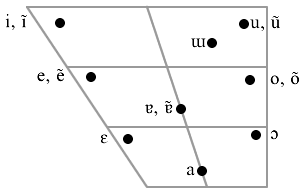
To the seven vowels of Vulgar Latin European Portuguese has added two near central vowels, one of which tends to be elided in rapid speech, like the e caduc of French. The five nasal vowels can be regarded as allophones of oral vowels, found in special environments. The high vowels /e o/ and the low vowels /ɛ ɔ/ are four distinct phonemes, and they alternate in various forms of apophony. Like Catalan, Portuguese uses vowel quality to contrast stressed syllables with unstressed syllables: isolated vowels tend to be raised, and in some cases centralized, when unstressed. Nasal diphthongs exist, occurring mostly at the end of words.
Consonants
Consonant phonemes of Portuguese
Bilabial Labio-
dental Dental Alveolar Post-
alveolar Palatal Velar Uvular
Plosives p b t d k g
Nasals m n ɲ
Fricatives f v s z ʃ ʒ ʁ
Flaps ɾ
Laterals l ʎ
Whereas its vowel phonology can be considered innovative, the consonant inventory of Portuguese is fairly conservative. The medieval affricates /ts/, /dz/, /tʃ/, /dʒ/ merged with the fricatives /s/, /z/, /ʃ/, /ʒ/, respectively, but not with each other, and there were no other significant changes to the consonant phonemes since then. However, some remarkable allophones and dialectal variants have appeared, among which:
* In most of Brazil, /t/ and /d/ have the affricate allophones [tʃ] and [dʒ], respectively, before /i/. (Quebec French has a similar phenomenon, with alveolar affricates instead of postalveolars.)
* At the end of a syllable, the phoneme /l/ has the velarized allophone [ɫ] in European Portuguese, like in the Received Pronunciation of English. Brazilian Portuguese has the allophone [w] instead (L-vocalization).
* In many parts of Brazil and Angola, /ɲ/ is pronounced as a nasal glide [j̃] which nasalizes the vowel before it, so that for instance /'niɲu/ is pronounced ['nĩj̃u].
* There is great dialectal variation in the value of the rhotic phonemes /ʁ/ and /ɾ/. See Guttural R in Portuguese, for details.
* In some dialects, the alveolar sibilant /s/ has postalveolar allophones [ʃ], [ʒ], at the end of syllables. (In Judeo-Spanish, /s/ has the allophone [ʃ] at the end of syllables, too.)
Stress
Primary stress may fall on any of the three final syllables of a word, but mostly on the last two. There is a partial correlation between the position of the stress and the final vowel; for example, the final syllable is usually stressed when it contains a nasal phoneme, a diphthong, or a close vowel. The orthography of Portuguese takes advantage of this correlation to minimize the number of diacritics.
Due to the phonetic changes that often affect unstressed vowels, pure lexical stress is less common in Portuguese than in related languages like Spanish, but there is still a significant number of examples of it:
dúvida [ˈduvidɐ] "doubt" (noun) vs. duvida [duˈvidɐ] "he doubts"
falaram [faˈlaɾɐ̃ũ] "they spoke" vs. falarão [falaˈɾɐ̃ũ] "they will speak" (in Brazilian Portuguese)
ouve ['ovi] "he hears" vs. ouvi [o'vi] "I heard" (in Brazilian Portuguese)
túnel ['tunɛɫ] "tunnel" vs. tonel [tu'nɛɫ] "wine cask" (in European Portuguese)
Prosody
Tone is not lexically significant in Portuguese, but phrase- and sentence-level tone are important. There are of six dynamic tone patterns that affect entire phrases, which indicate the mood and intention of the speaker such as implication, emphasis, reservation, etc. As in most Romance languages, interrogation is expressed mainly by sharply raising the tone at the end of the sentence.
Grammar
Portuguese grammar
The grammar of Portuguese has much in common with that of various other Romance languages, such as the existence of two copular verbs, two grammatical genders, and a large number of verb conjugations. It has also a few grammatical peculiarities not found in most other Romance languages, of which the most striking are the future subjunctive, the personal infinitive, the synthetic pluperfect, and the present perfect.
Future subjunctive
The future subjunctive tense, developed by medieval Ibero-Romance, is now old-fashioned in Spanish, but remains in vernacular use in Portuguese. It appears in dependent clauses that denote a condition which must be fulfilled in the future, so that the independent clause will occur. Other languages normally employ the present tense under the same circumstances:
Se for [future subjunctive] eleito presidente, mudarei a lei.
"If I am elected president, I will change the law."
Quando fores [future subjunctive] mais velho, vais entender.
"When you are older, you will understand."
Personal infinitive
It is possible for a verb in the infinitive to agree with its subject in person and number, often showing who is supposed to perform a certain act; cf. Está na hora de voltares "It is time (for you) to return.", Está na hora de voltarmos "It is time (for us) to return." This is called the personal infinitive, and no other Romance language has one, besides Galician and Sardinian[citation needed]; perhaps for this reason, infinitive clauses replace subjunctive clauses more often in Portuguese than in other Romance languages.
Present perfect
Many Romance languages possess a present perfect tense, but the Portuguese present perfect has a unique, iterative sense, denoting an action or a series of actions which have begun in the past and are expected to continue into the future. For instance, the meaning of Tenho tentado falar com ela may be closer to "I have been trying to talk to her" than to "I have tried to talk to her", depending on the context, and the correct translation of the question "Have you heard the latest news?" is Ouviu a última notícia?, not *Tem ouvido a última notícia?
Writing system
Orthography of Portuguese
Portuguese is written with the Latin alphabet, and makes use of the acute accent, the circumflex accent, the grave accent, the tilde, and the cedilla, to denote stress, vowel height, nasalization, and other sound changes. Brazilian Portuguese also uses the diaeresis mark. Accented letters and digraphs are not counted as separate characters.
Brazilian vs. European orthography
There are some differences between the orthographies of Brazil and other Portuguese language countries. One of the most pervasive is the use of acute accents in the European orthography in many words such as sinónimo, where the Brazilian orthography has a circumflex accent, sinônimo. Another important difference is that Brazilian spelling often lacks p or c before c, ç, or t, where the European orthography has them; e.g. ótimo vs. óptimo, or fato vs. facto. Some of these spelling differences reflect differences in the pronunciation of the words, but others are merely graphic.
Examples
Excerpt from «The Lusiads» (I, 33)
Translation Original IPA
Affectionate for the Lusitanian people, Afeiçoada à gente Lusitana, ɐfɐi̯su̯ˈaða ˈʒẽtɨ luziˈtɐnɐ
For all the qualities she saw in them, Por quantas qualidades via nela puɾ ˈku̯ɐ̃tɐʃ ku̯ɐliˈðaðɨʒ ˈviɐ ˈnɛlɐ
Of her beloved old Roman folk, Da antiga tão amada sua Romana; dãˈtigɐ tɐ̃ũ ̯ ɐˈmaðɐ ˈsuɐ ʁuˈmɐnɐ
In the strong hearts, in the great star, Nos fortes corações, na grande estrela, nuʃ ˈfɔɾtɨʃ kuɾɐˈsõĩ ̯ʃ nɐ ˈgɾɐ̃dɨʃˈtɾelɐ
That they had shown in the lands of Tangiers, Que mostraram na terra Tingitana, kɨ muʃˈtɾaɾɐ̃ũ ̯ nɐ ˈtɛʁɐ tĩʒiˈtɐnɐ
And in their language, which when she imagines, E na língua, na qual quando imagina, i nɐ ˈlĩgu̯ɐ nɐ ku̯aɫ ˈku̯ɐ̃du̯imɐˈʒinɐ
With little strain she can believe is the Latin tongue, Com pouca corrupção crê que é a Latina. kõ ˈpokɐ kuʁupˈsɐ̃ũ ̯ kɾe ki̯ɛ ɐ lɐˈtinɐ
[edit]
See also
* Museum of the Portuguese Language
* Portuguese literature
* List of Portuguese language poets
* Camões Prize
* Instituto Camões
* Brazilian literature
* List of Brazilian poets
* Fernando Pessoa
* Lusitanic
* Portuguese in the United States
* Portuguese on the Internet
* Capeverdean Creole
* Saudade
* English as She Is Spoke
* Swadesh list of Portuguese words
Notes
* 1First and Second with first language speakers, respectively. Only counting figures from countries in the table "Portuguese language countries and Territories". Considering second language speakers those people who are bilingual and use Portuguese as a second language.
References General
* A Língua Portuguesa in Universidade Federal do Rio Grande do Norte, Brazil
Literature
* Poesia e Prosa Medievais Ulisseia 1998 (3rd ed.; ISBN 9789725681244).
* Bases Temáticas - Língua Portuguesa in Instituto Camões
* Portuguese Literature in The Catholic Encyclopedia
Phonology, orthography and grammar
* International Phonetic Association (1999) Handbook of the International Phonetic Association ISBN 0-521-63751-1
* Mateus, Maria Helena & d'Andrade, Ernesto (2000) The Phonology of Portuguese ISBN 0-19-823581-X
* Mario Squartini (1998) Verbal Periphrases in Romance -- Aspect, Actionality, and Grammaticalization ISBN 3-11-016160-5
* Bergström, Magnus & Reis, Neves Prontuário Ortográfico Editorial Notícias, 2004.
Reference dictionaries
* Antônio Houaiss (2000), Dicionário Houaiss da Língua Portuguesa (228,500 entries).
* Aurélio Buarque de Hollanda, Novo Dicionário da Língua Portuguesa (1809pp)
Linguistic studies
* Lindley Cintra, Luís F. Nova Proposta de Classificação dos Dialectos Galego-Portugueses Boletim de Filologia, Lisboa, Centro de Estudos Filológicos, 1971.
For all the qualities she saw in them, Por quantas qualidades via nela puɾ ˈku̯ɐ̃tɐʃ ku̯ɐliˈðaðɨʒ ˈviɐ ˈnɛlɐ
Of her beloved old Roman folk, Da antiga tão amada sua Romana; dãˈtigɐ tɐ̃ũ ̯ ɐˈmaðɐ ˈsuɐ ʁuˈmɐnɐ
In the strong hearts, in the great star, Nos fortes corações, na grande estrela, nuʃ ˈfɔɾtɨʃ kuɾɐˈsõĩ ̯ʃ nɐ ˈgɾɐ̃dɨʃˈtɾelɐ
That they had shown in the lands of Tangiers, Que mostraram na terra Tingitana, kɨ muʃˈtɾaɾɐ̃ũ ̯ nɐ ˈtɛʁɐ tĩʒiˈtɐnɐ
And in their language, which when she imagines, E na língua, na qual quando imagina, i nɐ ˈlĩgu̯ɐ nɐ ku̯aɫ ˈku̯ɐ̃du̯imɐˈʒinɐ
With little strain she can believe is the Latin tongue, Com pouca corrupção crê que é a Latina. kõ ˈpokɐ kuʁupˈsɐ̃ũ ̯ kɾe ki̯ɛ ɐ lɐˈtinɐ
[edit]
See also
* Museum of the Portuguese Language
* Portuguese literature
* List of Portuguese language poets
* Camões Prize
* Instituto Camões
* Brazilian literature
* List of Brazilian poets
* Fernando Pessoa
* Lusitanic
* Portuguese in the United States
* Portuguese on the Internet
* Capeverdean Creole
* Saudade
* English as She Is Spoke
* Swadesh list of Portuguese words
Notes
* 1First and Second with first language speakers, respectively. Only counting figures from countries in the table "Portuguese language countries and Territories". Considering second language speakers those people who are bilingual and use Portuguese as a second language.
References General
* A Língua Portuguesa in Universidade Federal do Rio Grande do Norte, Brazil
Literature
* Poesia e Prosa Medievais Ulisseia 1998 (3rd ed.; ISBN 9789725681244).
* Bases Temáticas - Língua Portuguesa in Instituto Camões
* Portuguese Literature in The Catholic Encyclopedia
Phonology, orthography and grammar
* International Phonetic Association (1999) Handbook of the International Phonetic Association ISBN 0-521-63751-1
* Mateus, Maria Helena & d'Andrade, Ernesto (2000) The Phonology of Portuguese ISBN 0-19-823581-X
* Mario Squartini (1998) Verbal Periphrases in Romance -- Aspect, Actionality, and Grammaticalization ISBN 3-11-016160-5
* Bergström, Magnus & Reis, Neves Prontuário Ortográfico Editorial Notícias, 2004.
Reference dictionaries
* Antônio Houaiss (2000), Dicionário Houaiss da Língua Portuguesa (228,500 entries).
* Aurélio Buarque de Hollanda, Novo Dicionário da Língua Portuguesa (1809pp)
Linguistic studies
* Lindley Cintra, Luís F. Nova Proposta de Classificação dos Dialectos Galego-Portugueses Boletim de Filologia, Lisboa, Centro de Estudos Filológicos, 1971.